

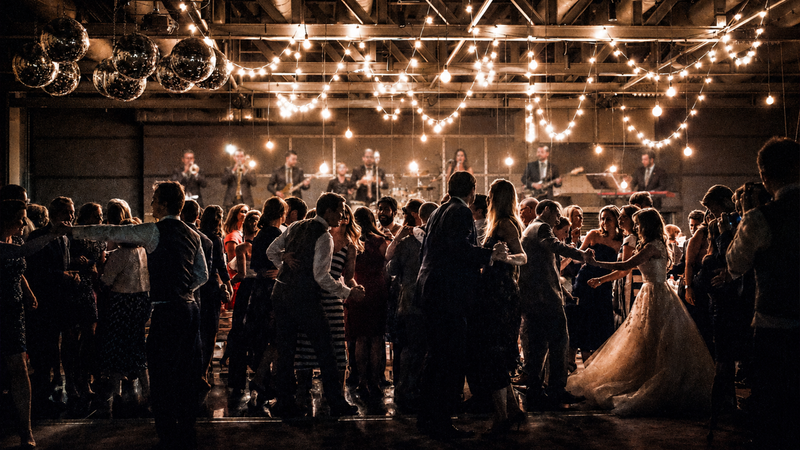
What Size Wedding Band Do You Need? Choosing the Right Line-up for Your Wedding
Not sure whether to book a small 3-4 piece wedding band or go all-out with a larger show band? This guide explains how band size affects sound, style, stage space, atmosphere and budget, helping you choose the right line-up for your wedding. Explore our full range of wedding bands, from compact rock and pop bands to larger soul and Motown bands and luxury function bands.
If you’re wondering whether you need a 4-piece or a 10-piece wedding band, how band size affects the music they can perform, or whether a bigger band actually creates a better party atmosphere, you’re not alone.
The reality is that different line-ups are built for completely different styles of music, so whilst you’re right to think about how much space you have, and whether bigger bands are worth it, it’s really more about choosing the right size band for the kind of music you love.
In this guide, we’ll explain how wedding band sizes affect sound, repertoire, atmosphere, staging, price, and overall impact, helping you choose the right line-up for your venue, your guests, and the kind of night you want to create.
Let’s break it down.
Quick Comparison Guide
| Band Size | Best For | Pros | Considerations |
|---|---|---|---|
| 3–4 Piece | Indie, Rock, Acoustic, Classic Chart Hits. | Most popular wedding band size, budget-friendly, compact, energetic. | Slightly limited musical range. |
| 5–7 Piece | Modern Pop & Rock, Dance, Chart Hits. | Full sound, flexible varied repertoire, often including female vocals, keys and sax. | Higher cost, needs moderate stage space. |
| 8–12 Piece | Soul, Motown, Funk, Swing, Chart Hits. | Brass, multiple vocalists, big impact, authentic soul & funk. | Much higher budget and larger stage required. |
| 12+ Piece | Bespoke arrangements of most music, luxury weddings. | Multiple lead singers, wow factor, immersive, wide repertoire. | Large budget and venue essential. |
First Things First: What Counts as a “Band”?
Technically, wedding entertainment can range from a solo acoustic singer right up to a 40-piece jazz orchestra. But when couples talk about booking a wedding band, they’re usually thinking of a 3-piece trio at the smallest and a full show band at the largest.
A soloist or duo can absolutely elevate your ceremony or drinks reception, and we regularly recommend them for earlier parts of the day, but for the evening party, most couples start their search at a trio or four-piece.
The most common line-ups look like this:
- 3-piece trio - the smallest traditional “band” line-up
- 4-5 piece band - the UK wedding sweet spot
- 6-9 piece band - brass, backing vocals, bigger impact
- 10-12+ piece show band - full soul/Motown authenticity
- Orchestral line-ups - for truly grand-scale celebrations
How Band Size Shapes What You Get
The biggest deciding factor in band size isn’t budget. It’s the style of music you want. Different genres are built around different line-ups, and trying to recreate a big soul sound with a four-piece will always be a compromise.
Here’s what you actually get at each level.
3–4 Piece Indie Rock & Pop Bands
If you’re dreaming of guitar anthems from The Beatles through to modern indie classics, a trio or four-piece is exactly where you should be looking. A tight three-piece can sound fantastic: energetic, punchy, and surprisingly full.
Add a fourth musician, such as keys or a second guitar, and you gain more vocal harmony, more depth in the arrangements, and greater flexibility on the night.
Professional bands today may incorporate subtle playback elements, such as synths, textural layers and production touches, but adding live musicians always gives you more spontaneity and freedom.
If you want a dancefloor that feels full and powerful, a 4- or 5-piece often hits the sweet spot for this genre.
Examples: Happy Hour, The Royale, Hipster, Arcadias, Technicolour, Dirty Weekend, The Low Down, The Kicks, Live Wires
5–7 Piece Pop Party Bands
Step up to a five-to-seven-piece and you’re entering proper party band territory. This is where you add a female vocalist, keys as a standalone instrument, or an instrument such as saxophone, all of which open up a significantly wider contemporary pop repertoire.
These bands can move comfortably across decades and genres, from 80s classics through to current chart hits, with the vocal and instrumental range to do it convincingly.
If you want a band that can genuinely play anything and play it well, this is usually the size to be looking at.
Examples: Dexter, Seven, Happy Hour Deluxe, Switch, The Sonics, Evelyn and The Vipers, Jaguar, Jam Masters
8–12 Piece Soul, Motown, Swing & Show Bands
Now we’re talking! You can book a four-piece that plays soul classics, and many do it well, but if you want that authentic, spine-tingling Motown sound, the kind that genuinely feels like the record, you need brass, multiple vocalists, and often dedicated percussion alongside your rhythm section.
That means trumpet, sax, trombone, multiple singers, drums, bass, guitar, keys and percussion. That’s seven to twelve musicians, and every one of them earns their place on stage.
Why? Because those genres were built around those textures. If you close your eyes and imagine Stevie Wonder or Earth, Wind & Fire, the horns blazing and the harmonies stacking, then that’s the line-up you need.
Examples: Hipster And The Hot Hot Horns, The Swing Smiths, Soul Cartel, Get Funked, Funk Soul Stars, Soul Groove, Motor City Soul, The MBB Band, The Motownettes, Funk Up The Volume
What’s the Best Wedding Band Size for My Venue?
Couples sometimes overlook this until it’s almost too late. If your stage space is 4m x 3m, you’re not fitting a nine-piece comfortably, and a squeezed band never looks right.
Before you decide on size, check the following with your venue:
- Stage dimensions
- Ceiling height
- Power supply
- Sound limiter restrictions
- Access and load-in space
A large ballroom? Go big. A charming barn with limited space? A four-piece might be perfect, and a great one will fill the room.
We’ve seen incredible three-piece bands absolutely own a large venue, and equally we’ve seen oversized line-ups squeezed awkwardly into spaces that simply weren’t designed for them.
The band should look like they belong on that stage.
Don’t Forget: It’s About the Whole Day
Your evening band is the headline act, but live music throughout the day transforms the entire experience.
Ceremony musicians shape the emotional journey. Drinks reception acts keep energy high across that 90-120 minute window between ceremony and dinner. Post-meal entertainment bridges the gap before the party properly starts.
Many evening bands also offer smaller acoustic ceremony and daytime sets, which can be a brilliant way to maximise your budget without compromising impact.
See our article How to Make the Most of Your Wedding Band Throughout Your Day.
So… What Size Wedding Band Do You Really Need?
It comes down to three things.
- First, the music style: authentic soul needs brass, indie can thrive as a trio.
- Second, your vision: when you picture your dancefloor at its best, what does the band look like?
- Third, venue logistics: can the space actually handle the line-up you want?
If you’re unsure, that’s exactly where we come in.
At Alive Network, we’ve been matching couples with the right live entertainment since 1999. We’re not a directory. Every band is hand-picked, performance-proven, and trusted.
Because incredible events start with the right act. And when the dancefloor’s full and your guests are singing at the top of their lungs, you’ll know you chose the right size.

Posted by Dave Bevan, Managing Director
on Wed, 20th May 2026
More Wedding Entertainment Planning Advice
How To Choose The Perfect Live Band For Your Wedding
4th March 20264th Mar 2026 By Dave Bevan
Wedding Band Prices in 2026 / 2027
12th January 202612th Jan 2026 By Dave Bevan
How to Use Your Wedding Band Throughout Your Wedding Day
19th May 202619th May 2026 By Dave Bevan

Wedding Band vs Wedding DJ - Which Is Right For You?
13th March 202613th Mar 2026 By Dave Bevan
Smart Ways To Save Money On Your Wedding Band
6th October 20256th Oct 2025 By Dave Bevan




Registered offices: Ground Floor Suite, Silk Mill Studios, Princess Street, Newcastle-under-Lyme, Staffordshire, ST5 1DD, United Kingdom
All content © Copyright Alive Network 1999-2026. All rights reserved. Registered Company Number: 04084200
Some artists may appear with the kind co-operation and consent of their respective management companies.
This service is intended for personal use only and no part of the service may be displayed in public, broadcast or used for any business purpose without the consent of Alive Network. Whilst every effort is made to ensure the accuracy of our services and web content, we accept no responsibility for any use made of the information provided and we shall not be liable for any loss suffered thereby.